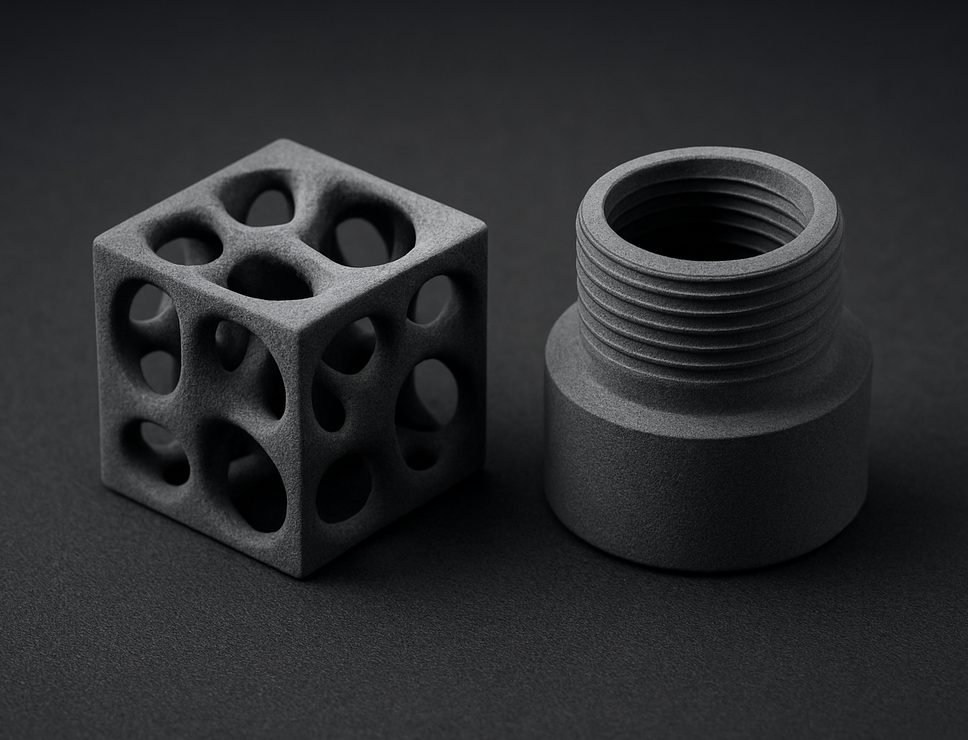
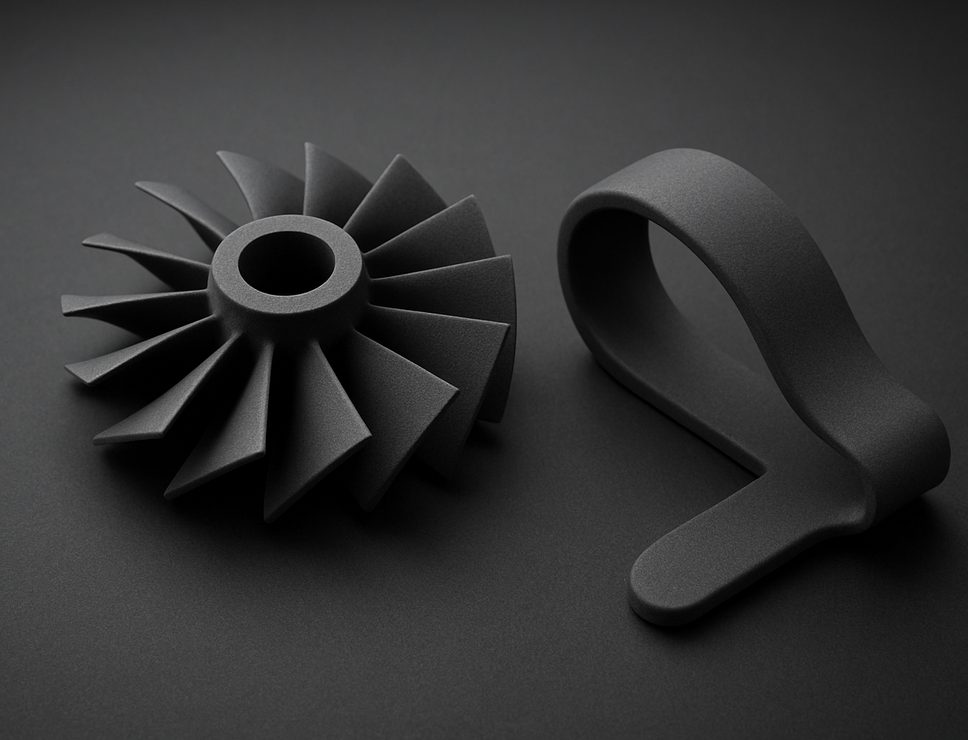
MJF Nylon PA12 is a high-performance HP Multi Jet Fusion material used for producing strong, detailed
parts with excellent surface finish. As a leading provider of Multi Jet Fusion 3D printing
in India, iamRapid uses HP PA 12 to deliver functional prototypes and end-use parts with balanced
mechanical properties and fine detail resolution. For glass-filled applications, see HP Glass-Filled Nylon.
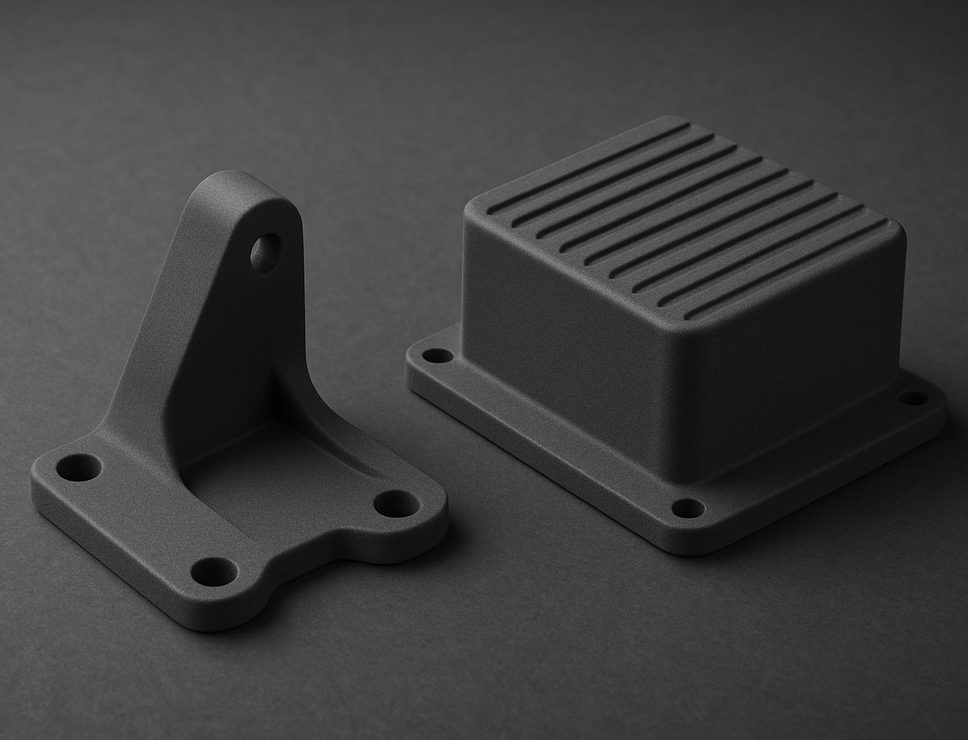
Material Name:
HP 3D High Reusability PA 12 (Black)
Description:
MJF Nylon PA12 is a polyamide 12 material designed for use with HP's
Multi Jet Fusion 3D printers, making it a leading HP Multi Jet Fusion
material for production applications. It offers a balanced combination of mechanical properties, including
strength, durability, and detail resolution. This MJF Nylon PA12 provides excellent surface finish and is
suitable for producing functional prototypes and end-use parts across various industries in India. Its
black color and high quality make it ideal for aesthetic applications without the need for painting or
dyeing. Order MJF Nylon PA12 3D prints in India through iamRapid.
Material Type:
Polyamide 12 (Nylon 12)
Price:
Available color:
Black
Process compatibility:
MJF compatible
Special Properties:
Balanced Mechanical Properties
Excellent Surface Finish
High Detail Resolution
Good Chemical Resistance
High Reusability of Powder
Limitations:
Limited Flexibility Compared to
Elastomers
Moderate Heat Resistance
May Require Post-Processing for
Sealing Porosity
Not ESD Safe Without Treatment
Material rating
Key HP 3D High Reusability PA 12 (Black) properties rated to guide you in selecting the best fit for your
3D printing needs.
Strength4 of 5
Flexibility3 of 5
Detail Resolution5 of
5
Surface Smoothness5 of
5
Heat Resistance3 of 5
Chemical Resistance3 of
5
Ease of Printing5 of 5
Cost Efficiency4 of 5
Applications
HP PA 12 is ideal for producing functional prototypes and end-use parts that require a
balance of strength, durability, and aesthetic appeal. Its fine detail resolution and excellent surface
finish make it suitable for a wide range of applications.
Engineering and Manufacturing Applications
Functional prototypes
Housings and Enclosures
Jigs and fixtures
Automotive and Aerospace Applications
Interior components
Brackets and mounts
Complex geometries
Consumer Products Applications
Electronics casings
Customized accessories
Sporting goods
Medical and Dental Applications
Prosthetics
Orthopedic models
Surgical instruments
Additional Applications
Complex Assemblies
Snap-Fit Designs
Interlocking Parts
Mechanical Properties
Offers a balanced combination of strength, toughness, and detail resolution, suitable for functional
applications.
Property
Value, metric
Tensile Strength
Approximately 48 MPa
Tensile Modulus
Approximately 1,650 MPa
Elongation at Break (%)
20%
Flexural Strength
Approximately 70 MPa
Flexural Modulus
Approximately 1,600 MPa
Notched Izod Impact Strength
Approximately 3.5 kJ/m^2
Shore Hardness
Shore D 75
Characteristics
Printing with HP PA 12 involves using Multi Jet Fusion technology, where a fusing agent
and detailing agent are applied to layers of powder, which are then fused using infrared light. The process
allows for high detail resolution, excellent surface finish, and uniform mechanical properties.
Post-processing may include bead blasting and finishing techniques to enhance appearance.
Type
Value
Lead Time
2-7 business days
Wall Thickness
Minimum 0.7 mm
Tolerance
±0.3%, minimum ±0.3 mm
Max Part Size
Up to 284x 380 x 380 mm
Layer Height
-
Thermal Properties
Exhibits good thermal stability and can withstand moderate temperatures without
significant deformation.
Property
Value, metric
Heat Deflection Temperature (HDT)
Approximately 95°C at 0.45 MPa
Thermal Expansion Coefficient
Approximately 100 x 10^-6 /°C
Thermal Conductivity
Approximately 0.1 W/m·K
Max Service Temperature
Up to 80°C for continuous use
Electrical Properties
Acts as an electrical insulator with good dielectric properties, suitable for electrical
and electronic components.
Property
Value, metric
Dielectric Strength
Approximately 30 kV/mm
Dielectric Constant (1 MHz)
Approximately 3.5
Volume Resistivity
Approximately 10^12 Ω·cm
ESD Safety
Not ESD safe without treatment
NOTE: The provided
values are approximate and can vary
based on the specific HP 3D High Reusability PA 12 (Black) formulation and
manufacturer. Always refer to the manufacturer's technical data
sheet for precise information.
Find your queries
Frequently Asked Question(FAQ)
General
Printing
Post-procesing
Troubleshooting
Advanced
What is MJF Nylon PA12 and why is it a popular HP Multi Jet Fusion material?
MJF Nylon PA12 is a polyamide 12 powder optimized for HP Multi Jet Fusion 3D printers. As
a widely used HP Multi Jet Fusion material, it delivers excellent mechanical properties, fine
detail resolution, and consistent surface finish for functional prototypes and production parts
in India.
How does HP PA 12 Glass Beads compare to standard HP PA 12?
Compared to standard HP PA 12, the glass beads version provides higher stiffness and dimensional
stability but is less flexible and slightly more brittle.
Is HP PA 12 Glass Beads suitable for functional parts?
Yes, it is ideal for functional prototypes and end-use parts that require high stiffness,
dimensional accuracy, and resistance to deformation under load.
Can HP PA 12 Glass Beads parts be dyed or colored?
Due to the presence of glass beads, the material has a gray color and may not accept dyes as
readily as unfilled PA 12. Painting is an option for adding color.
Is HP PA 12 Glass Beads abrasive to printing equipment?
Yes, the glass beads can cause increased wear on printer components. HP MJF printers are
designed to handle this material, but regular maintenance is recommended.
Are there special considerations when printing with HP PA 12 Glass Beads?
Yes, the material requires specific print parameters optimized for the glass-filled material.
It's important to use the recommended settings provided by HP.
What layer thickness is used in MJF printing with HP PA 12 Glass Beads?
Typical layer thickness is 80 microns, standard for HP's MJF technology.
Can I print fine details with HP PA 12 Glass Beads?
Yes, MJF technology allows for high detail resolution, although the presence of glass beads may
slightly affect surface finish.
Does HP PA 12 Glass Beads require special handling during printing?
Operators should follow HP's guidelines for material handling, including appropriate safety
measures due to the fine powder and glass content.
How does powder recycling work with HP PA 12 Glass Beads?
HP's MJF technology promotes high reusability. Unfused powder can be recycled according to HP's
specifications, typically mixing fresh and used powder to maintain material properties.
How can I improve the surface finish of HP PA 12 Glass Beads parts?
Post-processing methods such as bead blasting, sanding, or tumbling can improve surface
smoothness. Vapor smoothing may also be an option.
Can HP PA 12 Glass Beads parts be painted or coated?
Yes, parts can be painted or coated to enhance appearance and surface properties.
Is machining possible with HP PA 12 Glass Beads parts?
Yes, parts can be machined using appropriate tools, but the glass content may cause tool
wear.
Can HP PA 12 Glass Beads parts be joined together?
Mechanical fastening is preferred due to the material's reduced flexibility. Adhesive bonding is
possible with suitable adhesives..
How do I seal the surface of HP PA 12 Glass Beads parts?
Applying sealants or coatings can reduce porosity and improve surface properties, especially for
applications requiring fluid or air tightness.
Why are my HP PA 12 Glass Beads parts cracking or breaking?
Cracking can result from excessive stress or insufficient wall thickness. Design adjustments may
be necessary to accommodate the material's reduced flexibility.
What causes poor surface quality in HP PA 12 Glass Beads parts?
Incorrect printer settings, old or contaminated powder, or equipment issues can affect surface
quality. Ensure printer calibration and maintenance are up to date.
How do I prevent warping in my parts?
HP's MJF technology minimizes warping, but ensuring uniform wall thickness and proper part
orientation can further reduce the risk.
Why are small features not printing accurately?
The material's properties may slightly limit the resolution of fine features. Adjust design to
meet minimum feature sizes recommended by HP.
How do I reduce equipment wear when printing with HP PA 12 Glass Beads?
Regular maintenance and following HP's guidelines for material handling and equipment care will
help minimize wear.
Is HP PA 12 Glass Beads suitable for high-temperature applications?
Yes, it has enhanced thermal resistance, making it suitable for applications up to 125°C for
continuous use.
Can HP PA 12 Glass Beads parts be used outdoors?
The material has moderate UV resistance. For prolonged outdoor use, protective coatings are
recommended to prevent degradation.
How does moisture affect HP PA 12 Glass Beads parts?
The material is less susceptible to moisture absorption compared to unfilled nylon but can still
benefit from sealing if required by the application.
Are there health concerns with handling HP PA 12 Glass Beads powder?
Fine particles and glass content can pose inhalation risks. Use appropriate personal protective
equipment (PPE) and follow safety guidelines provided by HP.
How should I store HP PA 12 Glass Beads powder and printed parts?
Store in a cool, dry place, away from moisture and direct sunlight to maintain material
properties.
Explore Related 3D Printing Materials
This material is used with MJF 3D printing technology. Explore other materials that may suit your project: