Explore the versatility of Flexible Resin 80A—a durable photopolymer resin for SLA 3D printing, offering a
balance of flexibility and toughness with a Shore hardness of 80A, ideal for producing bendable parts,
prototypes, and functional components requiring flexibility.
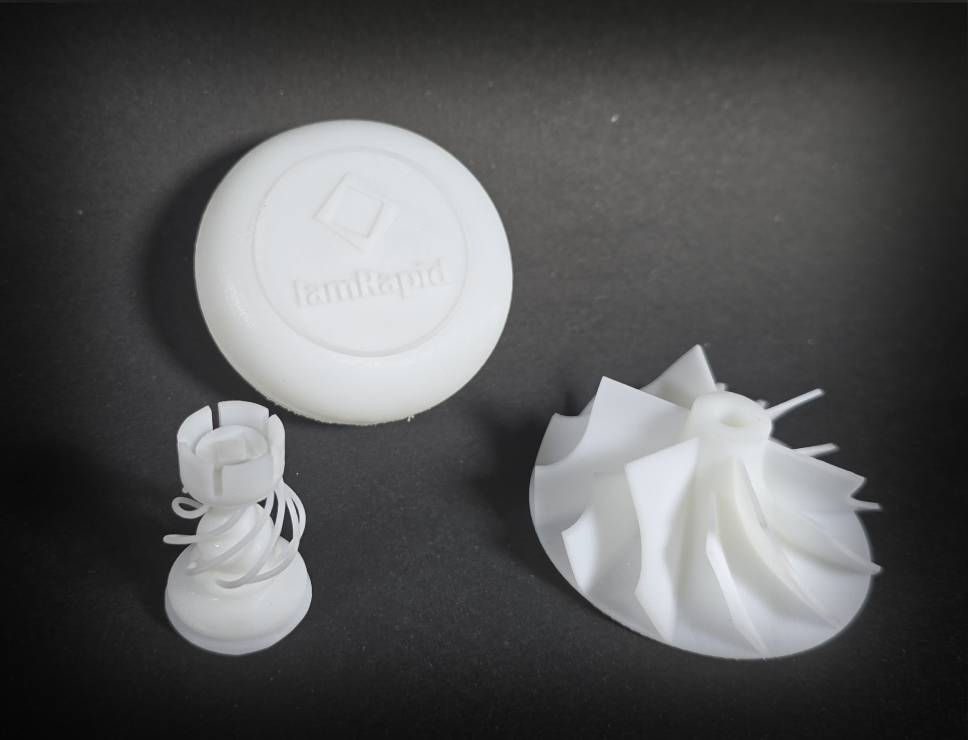
Material Name:
Flexible Resin 80A
Description:
Flexible Resin 80A is an elastomeric photopolymer resin for 3D printing, designed to produce parts that are both flexible
and durable. With a Shore hardness of 80A, it provides a balance between rigidity and elasticity, making
it suitable for applications that require parts to bend or compress under load but return to their
original shape. It is ideal for creating prototypes and end-use parts such as gaskets, seals, ergonomic
grips, and wearable devices. For even softer parts, consider Elastic Resin 60A.
Material Type:
Flexible Photopolymer Resin
Price:
Available color:
Black
Gray
Process compatibility:
SLA compatible
DLP compatible
Special Properties:
Flexible and Tough (Shore 80A)
Good Tear Resistance
Bendable and Compressible
Smooth Surface Finish
Limitations:
UV Sensitivity
Requires Post-Curing
Moderate Heat Resistance
Limited Chemical Resistance
Material rating
Key Flexible Resin 80A properties rated to guide you in selecting the best fit for your 3D printing needs.
Strength3 of 5
Flexibility4 of 5
Detail Resolution4 of
5
Surface Smoothness5 of
5
Heat Resistance2 of 5
Chemical Resistance2 of
5
Ease of Printing3 of 5
Cost Efficiency3 of 5
Applications
Flexible Resin 80A is suitable for producing parts that require flexibility and
durability. It is ideal for functional prototypes and end-use parts that must withstand bending, flexing,
and compression.
Engineering and Manufacturing Applications
Gaskets and seals
Overmolds
Flexible connectors
Consumer Products Applications
Ergonomic grips
Wearable device components
Protective cases
Medical Devices Applications
Prosthetics prototypes
Orthopedic models
Custom-fit devices
Automotive Applications
Vibration dampening parts
Flexible mounts
Interior components
Additional Applications
Functional Prototypes
Flexible Housings
Bendable Components
Mechanical Properties
Provides a balance of flexibility and toughness with good tear resistance, suitable for parts that require
bending and resilience.
Property
Value, metric
Tensile Strength
Approximately 7 MPa
Tensile Modulus
Approximately 80 MPa
Elongation at Break (%)
80%
Flexural Strength
Approximately 7 MPa
Flexural Modulus
Approximately 80 MPa
Notched Izod Impact Strength
Approximately 15 kN/m
Shore Hardness
Shore A 80
Characteristics
Printing with Flexible Resin 80A requires adjustments to support structures and print
settings to accommodate its flexibility. Post-processing includes thorough cleaning and UV curing to achieve
optimal mechanical properties.
Type
Value
Lead Time
2-5 business days
Wall Thickness
Minimum 1.0 mm
Tolerance
±0.1%, minimum ±0.05 mm
Max Part Size
Up to 600x 600 x 450 mm
Layer Height
-
Thermal Properties
Moderate heat resistance; parts may soften at elevated temperatures.
Property
Value, metric
Heat Deflection Temperature (HDT)
Approximately 40°C at 0.455 MPa
Thermal Expansion Coefficient
Approximately 200 x 10^-6 /°C
Thermal Expansion (Scale 0-100)
80
Max Service Temperature
Up to 45°C before significant deformation may occur
Electrical Properties
Acts as an electrical insulator; suitable for non-conductive applications.
Property
Value, metric
ESD Safety
Not ESD safe
Conductivity
Non-conductive; insulating properties
NOTE: The provided
values are approximate and can vary
based on the specific Flexible Resin formulation and
manufacturer. Always refer to the manufacturer's technical data
sheet for precise information.
Find your queries
Frequently Asked Question(FAQ)
General
Printing
Post-procesing
Troubleshooting
Advanced
What is Flexible Resin 80A, and what are its main characteristics?
Flexible Resin 80A is an elastomeric photopolymer resin with a Shore hardness of 80A, offering a
balance of flexibility and toughness suitable for parts that need to bend and flex.
How does Flexible Resin 80A compare to Elastic Resin 60A?
Flexible Resin 80A is slightly harder and less flexible than Elastic Resin 60A, making it
suitable for applications that require more durability and less softness.
Is Flexible Resin 80A suitable for functional parts?
Yes, it is ideal for functional prototypes and end-use parts that need to withstand bending,
compression, and repeated use.
Can Flexible Resin 80A be used for overmolding applications?
Yes, it can simulate overmolded parts when printed over or assembled with rigid
components.
Does Flexible Resin 80A require special storage conditions?
Store it in a cool, dark place away from direct sunlight and UV light sources. Keep the
container sealed tightly.
Are there any special considerations when printing with Flexible Resin 80A?
Adjust support structures to accommodate the material's flexibility, and handle parts carefully
to prevent deformation during printing and post-processing.
What layer height is recommended for printing with Flexible Resin 80A?
Layer heights between 50-100 microns are recommended, balancing detail resolution and printing
time.
Do I need to adjust exposure settings for Flexible Resin 80A?
Yes, follow the manufacturer's recommended exposure settings to ensure proper curing and
mechanical properties.
Can I print intricate details with Flexible Resin 80A?
Yes, but very fine features may be challenging due to the material's flexibility. Design
considerations may be needed.
Is an open or closed resin system better for printing with Flexible Resin 80A?
Either system can be used, but ensure that the resin is protected from light exposure and
contaminants.
How should I handle Flexible Resin 80A prints during post-processing?
Handle with care to avoid deforming the parts. Supports should be removed carefully to prevent
damage.
How long should I UV cure Flexible Resin 80A prints?
Curing times of 30-60 minutes are recommended to achieve full mechanical properties. Use a UV
curing station with appropriate settings.
Can Flexible Resin 80A prints be painted or finished?
Yes, they can be painted using flexible paints or coatings. Priming may improve adhesion.
How do I remove support structures without damaging the print?
Use sharp tools to carefully cut supports, and consider soaking the part in warm water to ease
removal.
Is it possible to bond Flexible Resin 80A parts together?
Yes, using adhesives suitable for flexible plastics or by using mechanical fastening
methods.
Why are my Flexible Resin 80A prints warping or deforming?
Warping can occur due to internal stresses or improper support. Ensure adequate supports and
adjust print settings.
What causes surface imperfections in my prints?
Surface defects can result from resin contamination, incorrect exposure settings, or
environmental factors. Keep the resin clean and adjust settings as needed.
How do I prevent tearing or breaking of thin features?
Design features with adequate thickness (minimum 1.0 mm) and handle prints gently during
post-processing.
Why are my prints sticky after curing?
Incomplete curing can cause stickiness. Ensure sufficient curing time and proper UV light
intensity.
How do I fix issues with prints being too stiff or too flexible?
Verify that the resin is properly mixed and that the curing process is correctly followed.
Adjusting exposure settings may also help.
Can Flexible Resin 80A be used for parts requiring repeated flexing?
Yes, it is designed to withstand repeated bending and flexing, making it suitable for hinges,
springs, and similar applications.
How does temperature affect Flexible Resin 80A parts?
The resin has moderate heat resistance but may soften at elevated temperatures above
45°C.
Is Flexible Resin 80A suitable for creating airtight seals?
It can be used for gaskets and seals, but testing is recommended to ensure performance meets
application requirements.
Can I mix Flexible Resin 80A with other resins to adjust properties?
Mixing resins is not recommended due to potential unpredictable results and compromised material
properties.
How should I store Flexible Resin 80A to maintain its properties?
Store in its original container, sealed tightly, away from light and heat sources. Keep in a
cool, dark place.
Explore Related 3D Printing Materials
This material is used with SLA 3D printing technology. Explore other materials that may suit your project: